Most construction, trade and equipment hire businesses are already doing marketing in some form. They have a website, a Google Business Profile, project photos, referrals, vehicle signage, social media posts or Google Ads.
That effort should not be dismissed. For many family-run or owner-operated businesses, marketing happens around quoting, job scheduling, staff, suppliers, site issues and customer calls. It is usually handled by the owner, a partner, an admin team member or an external provider working on one part of the picture.
The real gap is often management.
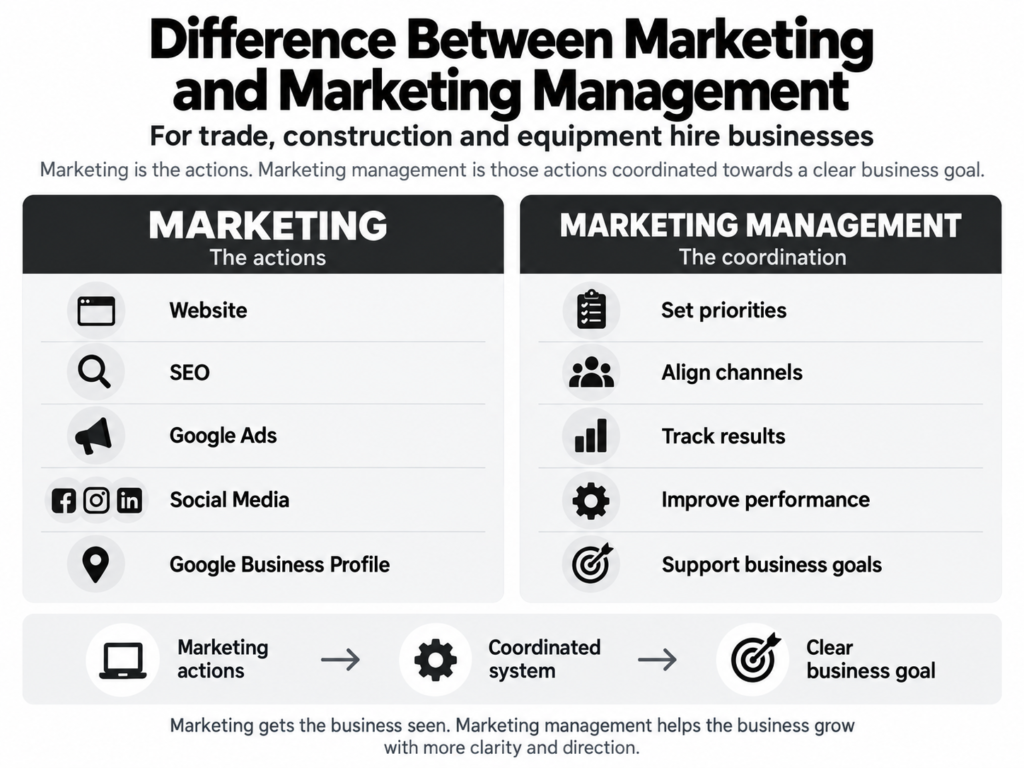
Marketing gets the business seen. Marketing management organises the work behind that visibility so the business can understand what is producing phone calls, quote requests, local awareness, stronger presentation and better sales follow up.
For electricians, plumbers, painters, roofers, concreters, builders, civil contractors and hire businesses across Southeast Queensland, Brisbane, Ipswich, Gold Coast and Sunshine Coast, that difference is practical. It affects how people find the business, how clearly they understand the offer and whether enquiries are followed up properly.
A search like “excavator hire Brisbane” is a good example. Marketing may help the business appear. Marketing management checks whether the page is clear, the phone number is easy to use, the enquiry is tracked, the hire team follows up and the business can see whether that search is worth investing in.
What is marketing?
Marketing is the work a business does to become visible, explain its services and encourage the right people to make contact. In construction, trade and hire, this can include website pages, SEO, Google Ads, social media, Google Business Profile updates, email marketing, project photos and brand material.
Marketing is what customers see before they call, email or request a quote.
For a trade business, marketing may show service areas, completed work, reviews and contact options. For a builder, it may explain project types, capability and trust. For a hire business, it may promote equipment categories, availability, delivery areas and phone enquiry options.
Common marketing activities include:
- Creating a service page for a high-intent search
- Posting completed work on social media
- Updating Google Business Profile photos
- Running Google Ads for urgent service enquiries
- Sending reminders to past clients
- Improving website calls to action
- Designing capability documents
- Building suburb or service area content
Marketing helps people understand what the business does, where it works and how to take the next step.
What is marketing management?
Marketing management is the planning, coordination, tracking and improvement of marketing activity. It connects websites, SEO, ads, social media, local search, CRM and content with the way the business wins work, handles enquiries and follows up quotes.
Marketing management looks beyond the task itself.
It asks practical business questions:
- Which services should be promoted first?
- Which locations are worth building visibility in?
- Are ads producing useful enquiries?
- Is the website clear enough for a builder, homeowner, site manager or procurement contact?
- Are phone calls and quote forms being tracked?
- Are enquiries followed up consistently?
- Is the business relying too heavily on referrals?
- Does the company look professional compared with competitors?
- Are reports written in plain language?
On Site Marketing Solutions works as an external marketing department that integrates closely with each client’s business.
Our Marketing Director works alongside owners, managers and internal teams to understand how the business operates, where growth opportunities exist and what marketing needs to support. This deeper understanding of each company’s business model allows us to manage marketing with greater context, explain performance in plain language and help the team make better-informed decisions.
Why marketing management is harder to handle in-house now
Most trade, construction and hire business owners are not ignoring marketing. Many already take photos, ask for reviews, answer enquiries, test ads, update profiles and try to stay visible while running the business.
The challenge is that marketing keeps changing.
Search behaviour changes. Google updates. AI Overviews and answer engines change how people find information. Google Ads needs stronger conversion tracking. Websites need clearer service structure. Social media needs consistent proof of work. CRM systems need clean follow-up data. What worked six months ago may need adjustment now.
Most hands-on owners do not have spare time to keep training themselves in marketing, SEO and AI search month after month. Their time is usually better spent pricing jobs, managing crews, keeping clients happy and running the business.
That is where managed support helps.
The aim is not to replace the effort already being made. It is to organise it, improve it and connect it with a clearer enquiry pathway.
For a concreter in Brisbane, that might mean turning completed project photos into stronger service pages and local proof. For a plumber on the Gold Coast, it might mean improving Google Ads tracking and Google Business Profile activity. For a hire business in Ipswich, it might mean clearer equipment category pages, better repeat customer follow up and more useful local search visibility.
At On Site, ongoing learning is part of the work. Marketing management now needs to account for traditional search, local visibility, AI SEO, answer-ready content, website usability, CRM follow up and the practical way trade and construction businesses operate.
What happens when marketing is active but not managed?
Marketing can be active and still feel unclear. A business may be spending money across a website, ads, SEO, social media and design, but still not know which activity is helping enquiries or where opportunities are being lost.
Common signs include:
- Website pages that do not clearly explain services
- Google Ads sending traffic to pages that do not convert well
- Social posts that show work without supporting the jobs the business wants
- Google Business Profile information becoming outdated
- Leads going to inboxes without a reliable follow-up process
- Phone calls not being tracked
- Quote requests not being connected to lead source
- Reports showing clicks without useful business context
- Project photos sitting on phones instead of supporting trust
- Past clients not being contacted for repeat work
- External providers working on separate tasks without one shared plan
The channel is not always the issue. SEO, Google Ads, social media, email and web design can all help when they sit inside a managed system.
Audit: understand the real starting point
The Audit stage reviews the business before more activity is added. It checks the website, Google Business Profile, search visibility, ads, content, CRM use and enquiry process. The goal is to find what is already helping and what is making it harder for people to contact the business.
An electrician may have strong reviews but weak service pages. A roofer may have useful project photos but thin website content. A hire business may have equipment people search for but no clear category pages. A builder may look strong offline but fail to show that clearly online.
Fix: clean up what blocks enquiries
The Fix stage deals with the parts of marketing that make the business harder to find, understand or contact. This may include unclear copy, poor page structure, missing calls to action, weak mobile layout, incomplete tracking, outdated Google Business Profile details or enquiry handling gaps.
This stage often involves Web Development, Web Design, UX and UI, SEO, Google Ads, Google Business Profile Management and CRM. The purpose is simple: make the business easier to trust and easier to contact.
Grow: build a steadier marketing system
The Grow stage builds on a cleaner foundation. It may include ongoing SEO, AI SEO, Google Ads management, Meta Ads, social media content, email marketing and regular reporting.
Growth should match the business. A small trade business may need better local search and follow up before expanding ads. A builder may need stronger project proof and service positioning. A hire company may need equipment category content, local profile updates and repeat customer communication.
What are the objectives of marketing management?
The objectives of marketing management are to improve visibility, attract suitable enquiries, strengthen professional presentation, reduce wasted spend and make follow up easier to track. In construction, trade and hire, it should connect marketing with calls, quote requests, jobs, sales activity and repeat work.
Practical objectives include:
- Increase visibility in relevant service areas
- Generate more suitable phone calls and quote requests
- Improve the quality of website and Google Ads enquiries
- Help the business look more professional online
- Make service pages clearer and more useful
- Improve Google Business Profile activity
- Track calls, forms, quotes and follow up
- Use project proof more effectively
- Support past client communication
- Give owners plain language reporting
For an owner-operated trade business, this may mean knowing which enquiries came from SEO, Google Ads or referrals. For a construction business, it may mean stronger positioning and better project proof. For a hire business, it may mean clearer equipment visibility and repeat customer follow up.
When does a business need marketing management?
A business usually needs marketing management when marketing exists but the owner cannot clearly connect it with enquiries, quotes, jobs or follow up. This is common in trade, construction and hire businesses where marketing is handled around daily operations.
Signs include:
Most work still comes from referrals
The business has tried agencies and felt unclear about the value
Reports are difficult to understand
Website traffic exists but enquiry quality is unknown
Ads are running without useful call or form tracking
Social media is inconsistent
Google Business Profile has not been updated properly
Project photos are not being used well
Enquiries are not followed up in a consistent way
No one owns the full marketing process
Marketing management gives the business someone responsible for the bigger picture.