Which Gives You Better Marketing Support?
As a construction company grows, marketing often becomes fragmented.
The director approves Google Ads. Admin posts to social media when there is time. Project photos sit on site managers’ phones. A freelancer looks after the website. An SEO provider sends monthly reports. Yet nobody has a complete view of what is producing worthwhile enquiries.
That usually leads to a familiar question: should we hire a marketing manager or use a marketing agency?
For many builders, civil contractors, subcontractors and equipment hire companies, there is also a third option: combining the close coordination of an internal marketing manager with the specialist capability of an agency.
That is the space On Site Marketing Solutions is designed to fill.
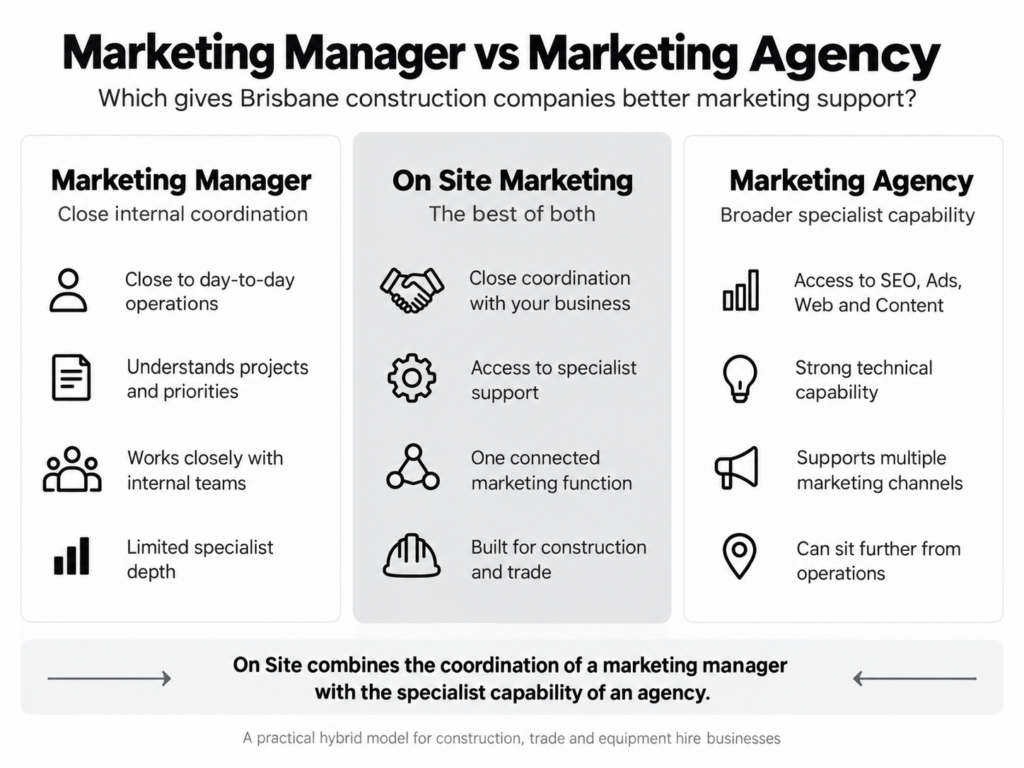
Marketing Manager vs Marketing Agency: What's the Difference?
An in-house marketing manager stays close to the day-to-day operation and coordinates priorities internally. An agency gives the company access to specialists across areas such as SEO, advertising, web, design and content.
The real distinction is between coordination and specialist capability.
An internal manager can work closely with directors, estimators, project managers and sales teams. They understand current projects, priorities and operational pressures.
External specialists bring deeper expertise across individual marketing disciplines.
Problems arise when one person is expected to do everything, or when several outside providers are working independently with nobody coordinating the overall direction.
When Does Each Model Work Best?
An in-house marketing manager
An internal marketing manager can be a strong option when marketing requires frequent coordination across projects, teams and management.
They may oversee:
- project updates and photography
- content approvals
- capability statements
- website requests
- campaign priorities
- supplier briefs
- reporting
Their main advantage is proximity to the operation.
The limitation is breadth. SEO, Google Ads, web development, design, content and CRM require different skills. One person can coordinate those areas, but rarely specialises deeply in all of them.
A marketing agency
An agency can suit a construction company that needs wider specialist capability without building a full internal team.
This becomes useful when SEO requires technical work, advertising needs closer management, the website needs improvement or several suppliers are already difficult to coordinate.
The weakness of a traditional agency model appears when marketing becomes detached from operations.
Generating ten leads means little if only two match the project types, service areas or contract values the company actually wants.
Someone searching “excavator hire Brisbane” may have strong intent, but the enquiry still needs to match machine availability, location and job requirements.
Understanding those commercial details is just as important as generating the lead.
Where Does On Site Marketing Fit?
On Site combines dedicated marketing coordination with access to a broader specialist team.
The model is built for construction and trade companies that need someone to stay close to their priorities while also bringing in the right expertise for Google ADS, SEO, Meta Ads, web, design, content and other marketing functions.
Instead of asking the owner to manage several disconnected suppliers, On Site creates a more coordinated marketing function around the company.
That means the people handling marketing can work from information such as:
- which services the company wants to grow
- which projects are worth quoting
- where crews can operate
- what equipment or capacity is available
- which enquiries are suitable
- what sales and estimating teams need
Specialist work can then be handled by the right person rather than expecting one marketing manager to execute every discipline.
Why This Model Can Work Well in Construction
Construction marketing depends heavily on information that sits inside the operation.
An SEO specialist cannot know which services need more visibility unless the business tells them. A Google Ads manager cannot judge lead quality without feedback from estimating. A content writer cannot describe project capability without input from people close to the work.
A coordinated model creates a clearer flow between those groups.
Rather than marketing operating separately from the rest of the company, campaigns and content can reflect real commercial priorities.
That also gives management a more useful way to assess performance.
Website traffic and enquiry counts are helpful, but stronger reporting asks what happened next:
- Was the enquiry suitable?
- Did it reach estimating?
- Was a quote submitted?
- Did it become a genuine sales opportunity?
That is far closer to how construction companies judge whether marketing is contributing to growth.
Get the Benefits of Coordination and Specialist Marketing Support
The choice does not have to be limited to employing one marketing manager or handing everything to a traditional agency.
On Site Marketing Solutions combines dedicated marketing coordination with access to specialists, giving construction and trade companies a practical way to manage marketing as one connected function.
Learn more about Marketing Management and On Site Support:
https://onsitemarketing.com.au/services/
Let’s talk about your next stage of growth.